
Hopefully none of my students read this before tomorrow, and I really should stop pre-empting my actions but giving gets me so excited. So I am picking 15 books from personal bookshelf catalogue and giving them away.
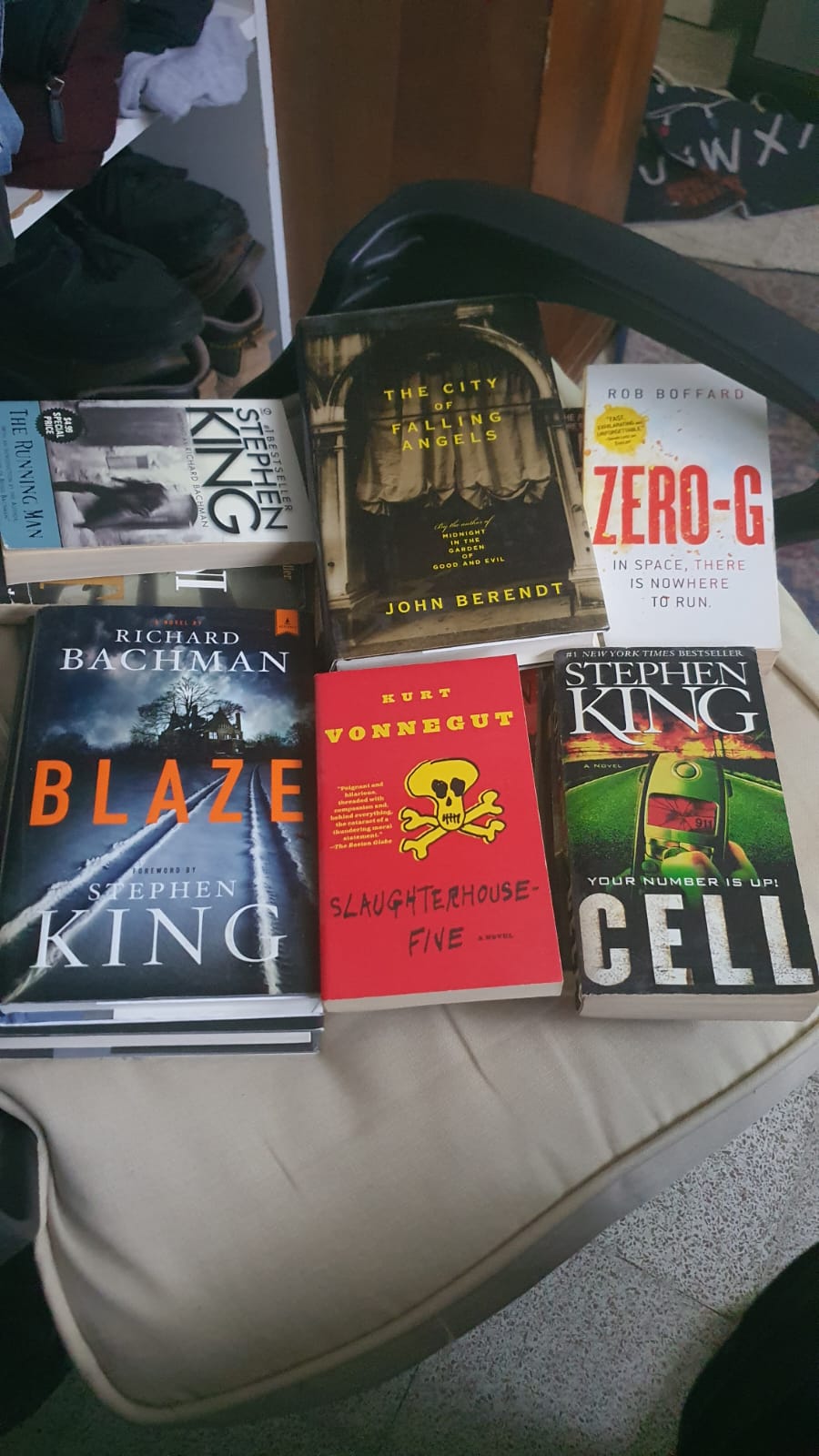
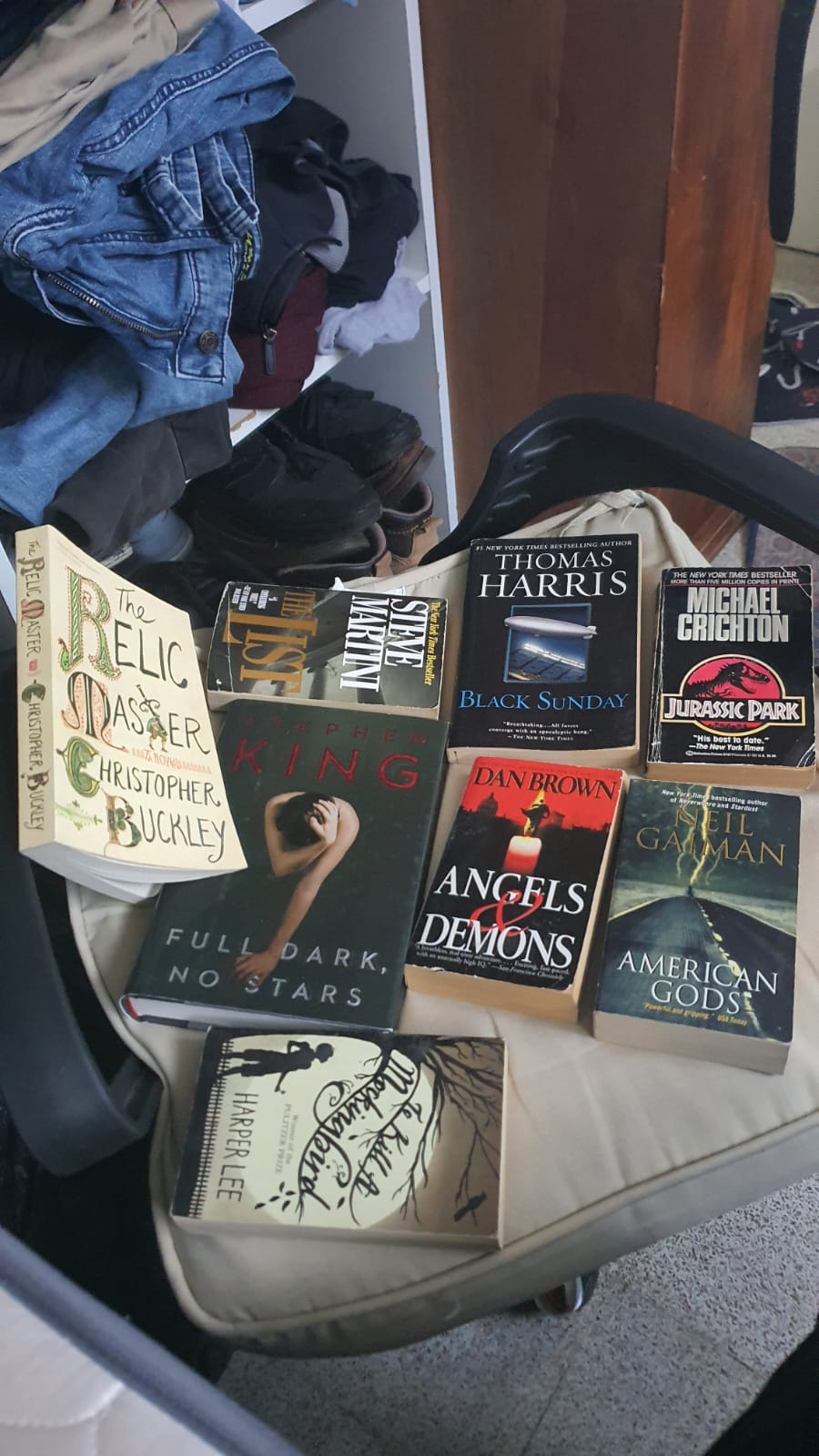
📚 Personal Bookshelf Catalogue
| # | Book | Author | Genre | Publication | Series / Order |
|---|---|---|---|---|---|
| 1 | The Running Man | Stephen King (as Richard Bachman) | Dystopian thriller / science fiction | 1982 | Standalone; part of the Bachman Books collection |
| 2 | The City of Falling Angels | John Berendt | Narrative nonfiction / travel writing | 2005 | Standalone; Berendt’s 2nd book |
| 3 | Zero-G | Rob Boffard | Science fiction / space thriller | 2016 | Outer Earth #2 — after Tracer |
| 4 | Blaze | Richard Bachman / Stephen King | Crime / psychological thriller | 2007 | Standalone; final published Bachman novel |
| 5 | Slaughterhouse-Five | Kurt Vonnegut | Science fiction / anti-war / satire | 1969 | Standalone |
| 6 | Cell | Stephen King | Horror / apocalyptic thriller | 2006 | Standalone |
| 7 | The Relic | Douglas Preston & Lincoln Child | Horror / science thriller | 1995 | Pendergast #1 |
| 8 | The Shining | Stephen King | Horror / psychological horror | 1977 | The Shining #1; followed by Doctor Sleep |
| 9 | Full Dark, No Stars | Stephen King | Horror / dark fiction / novellas | 2010 | Standalone collection of 4 novellas |
| 10 | Black Sunday | Thomas Harris | Thriller / crime / suspense | 1975 | Standalone |
| 11 | Jurassic Park | Michael Crichton | Science fiction / techno-thriller | 1990 | Jurassic Park #1; followed by The Lost World |
| 12 | Angels & Demons | Dan Brown | Mystery / thriller | 2000 | Robert Langdon #1 |
| 13 | American Gods | Neil Gaiman | Fantasy / mythology / road novel | 2001 | American Gods universe; followed by Anansi Boys (related rather than a direct sequel) |
| 14 | To Kill a Mockingbird | Harper Lee | Literary fiction / Southern Gothic / coming-of-age | 1960 | Standalone |
| 15 | The List | Steve Martini | Legal / suspense thriller | 1997 | Standalone |
I think it is a good mix of popular classics and will be quite a fun exploration of different worlds, genres, and styles. A few of the bibliographic details are particularly well supported: Zero-G is explicitly Outer Earth #2, with Tracer preceding it and Impact concluding the trilogy. (Hachette Book Group) The Relic is the first Preston/Child collaboration and the beginning of the Pendergast sequence. (Preston Child) Jurassic Park is followed by The Lost World, while Angels & Demons is identified as the first Robert Langdon novel. (Wikipedia)
📖 Recommended Reading Sequence
Rather than simply reading chronologically, I’d structure the 15-book pile into five mini-arcs so that you get variety rather than five or six thrillers in a row.
Phase 1 — The classics
1. To Kill a Mockingbird — Harper Lee
1960 · Literary fiction
⬇️
2. Slaughterhouse-Five — Kurt Vonnegut
1969 · Science fiction / satire
⬇️
3. The Shining — Stephen King
1977 · Horror
This gives you three very different kinds of classic American fiction before moving heavily into modern thrillers. The Shining was published in 1977 and is the first novel in the story that later continues with Doctor Sleep. (Stephen King)
Phase 2 — Suspense & paranoia
4. Black Sunday — Thomas Harris
1975 · Thriller
⬇️
5. The Running Man — Richard Bachman / Stephen King
1982 · Dystopian thriller
⬇️
6. The List — Steve Martini
1997 · Suspense / legal thriller
Black Sunday was Harris’s first novel, published in 1975. (Wikipedia) The Running Man was originally published under King’s Richard Bachman pseudonym in 1982. (Wikipedia) Martini’s The List was published in 1997 and is classified by Martini himself as suspense. (Steve Martini)
Phase 3 — Big-concept thrillers
7. Jurassic Park — Michael Crichton
1990 · Science fiction / techno-thriller
⬇️
8. The Relic — Preston & Child
1995 · Horror / science thriller
⬇️
9. Angels & Demons — Dan Brown
2000 · Mystery / thriller
This is probably the most obvious “I just want a page-turner” section of the collection.
Jurassic Park is the first book in Crichton’s Jurassic Park sequence. (Google Books)
Phase 4 — Darker modern fiction
10. Blaze — Richard Bachman / Stephen King
2007 · Crime / psychological thriller
⬇️
11. Cell — Stephen King
2006 · Horror / apocalyptic thriller
⬇️
12. Full Dark, No Stars — Stephen King
2010 · Four novellas
There is an interesting reason to keep Full Dark, No Stars toward the end of this section: unlike the novels, it is a collection of four novellas, rather than one continuous story. King’s official site dates it to November 2010. (Stephen King)
Phase 5 — Change of scenery
13. The City of Falling Angels — John Berendt
2005 · Narrative nonfiction / travel
⬇️
14. American Gods — Neil Gaiman
2001 · Fantasy / mythology
⬇️
15. Zero-G — Rob Boffard
2016 · Space thriller
This final group deliberately moves away from conventional crime/horror.
The City of Falling Angels is Berendt’s nonfiction portrait of Venice following the 1996 La Fenice fire. (PenguinRandomhouse.com) American Gods is a 2001 fantasy novel centered on the conflict between old and new gods. (Wikipedia)
And don’t start Zero-G until you’ve read Tracer if you want the Outer Earth story in order: Zero-G is explicitly Book 2, followed by Impact. (Kobo Books Blog)
⭐ The series gives you a start…
The books are more interconnected than they initially appears:
🦖 Jurassic Park
- Jurassic Park — 1990
- The Lost World — 1995
You currently own #1. (Wikipedia)
👁️ Pendergast
- The Relic — 1995
- The Cabinet of Curiosities
- Still Life with Crows
- Brimstone
- Dance of Death
- The Book of the Dead
- The Wheel of Darkness
- Cemetery Dance
- Fever Dream
- Cold Vengeance
…and many more.
You own #1, so The Relic is a natural gateway into a much larger series. The authors’ site confirms it was the book that started their collaboration. (Preston Child)
🚀 Outer Earth
- Tracer
- Zero-G
- Impact
You own #2, so Tracer is the obvious missing book if you want to complete the trilogy. (Hachette UK)
🕵️ Robert Langdon
- Angels & Demons
- The Da Vinci Code
- The Lost Symbol
- Inferno
- Origin
You already have the first Langdon novel, published in 2000. (Dan Brown Official Website)
🏨 The Shining
- The Shining
- Doctor Sleep
You have #1. King’s official bibliography confirms The Shining was released in January 1977. (Stephen King)
🗂️ Your new bookshelf by genre
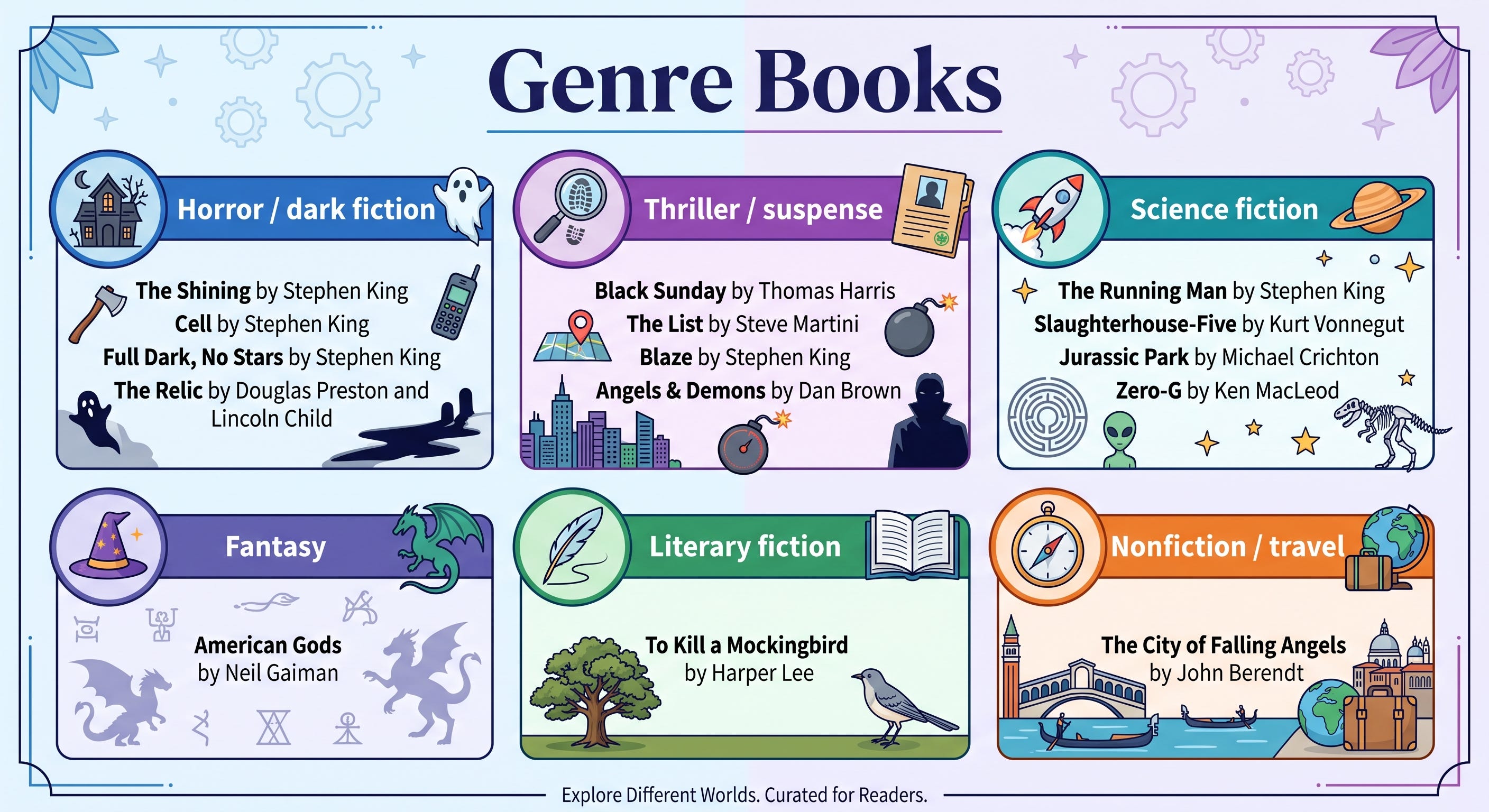
Author breakdown
Stephen King / Richard Bachman — 5
- The Running Man
- Blaze
- Cell
- The Shining
- Full Dark, No Stars
Everyone else — 1 each
- John Berendt
- Rob Boffard
- Kurt Vonnegut
- Douglas Preston & Lincoln Child
- Thomas Harris
- Michael Crichton
- Dan Brown
- Neil Gaiman
- Harper Lee
- Steve Martini
Happy Reading
I checked the current legal free-reading options. For these books, the main legitimate route is Open Library / Internet Archive, where some editions can be borrowed and read in the browser, sometimes with EPUB/PDF lending options. Open Library says borrowed books can be read online and, for eligible loans, downloaded in EPUB/PDF formats.
I won’t link to unauthorized/pirated PDF sites, but I can give you the legitimate free options.
📚 Your bookshelf — free reading/borrowing links
| # | Book | Free legal option |
|---|---|---|
| 1 | The Running Man — Stephen King / Richard Bachman | Search Open Library |
| 2 | The City of Falling Angels — John Berendt | Search Open Library |
| 3 | Zero-G — Rob Boffard | Search Open Library |
| 4 | Blaze — Richard Bachman / Stephen King | Search Open Library |
| 5 | Slaughterhouse-Five — Kurt Vonnegut | Borrow available on some editions: Open Library editions |
| 6 | Cell — Stephen King | Search Open Library |
| 7 | The Relic — Preston & Child | Search Open Library |
| 8 | The Shining — Stephen King | Borrow available on some editions: Open Library editions |
| 9 | Full Dark, No Stars — Stephen King | Search Open Library |
| 10 | Black Sunday — Thomas Harris | Search Open Library |
| 11 | Jurassic Park — Michael Crichton | Search Open Library |
| 12 | Angels & Demons — Dan Brown | Borrow available on some editions: Open Library editions |
| 13 | American Gods — Neil Gaiman | Search Open Library |
| 14 | To Kill a Mockingbird — Harper Lee | Open Library editions |
| 15 | The List — Steve Martini | Search Open Library |
How the free borrowing works
Open Library is particularly useful here because it isn’t simply offering random downloadable copies. It operates a digital lending library: eligible books can be borrowed for free, opened in its BookReader, and some loans provide EPUB/PDF download options.
You’ll generally see one of these:
- Read → read immediately in your browser
- Borrow → free digital loan
- Preview → only a limited preview
- Locate → helps you find a physical library copy
Open Library currently says you can borrow up to 10 books at a time, with fully borrowable loans generally lasting 14 days.
⚠️ One important distinction
Project Gutenberg is another excellent free source, but it concentrates on older works whose U.S. copyright has expired.
Your 15 books are overwhelmingly modern copyrighted works, so Gutenberg isn’t likely to have legitimate full copies of these particular titles.
📱 Easiest approach
I’d start with Open Library and search your whole bookshelf there. You can create a free account, add the books to your reading list, and borrow whichever editions currently have lending availability. Open Library’s current help page confirms that registration is free.
Because all of these books are protected by copyright, there are no legal websites where you can permanently download them for free. However, there are completely legal ways to read them for free, as well as multiple major retailers where you can purchase them.
Free & Legal Options (Digital Borrowing)
You can read or listen to these books for free by checking them out digitally:
The Internet Archive (Open Library): This is a massive nonprofit digital library. You can create a free account and digitally borrow scanned versions of older editions of these books (like Slaughterhouse-Five or The Shining).
Libby (by OverDrive): If you have a local library card, you can use the Libby app or website to borrow the ebook or audiobook versions for free. You can read them directly in the app, download them for offline reading, or send them to a Kindle device (in the U.S.).

